| Audience | Data engineers, analytics engineers, and technical marketers |
| Prerequisites | An Identity Resolution project |
Understand how Identity Resolution groups records, applies matching rules, and maintains identity stability over time.
Overview
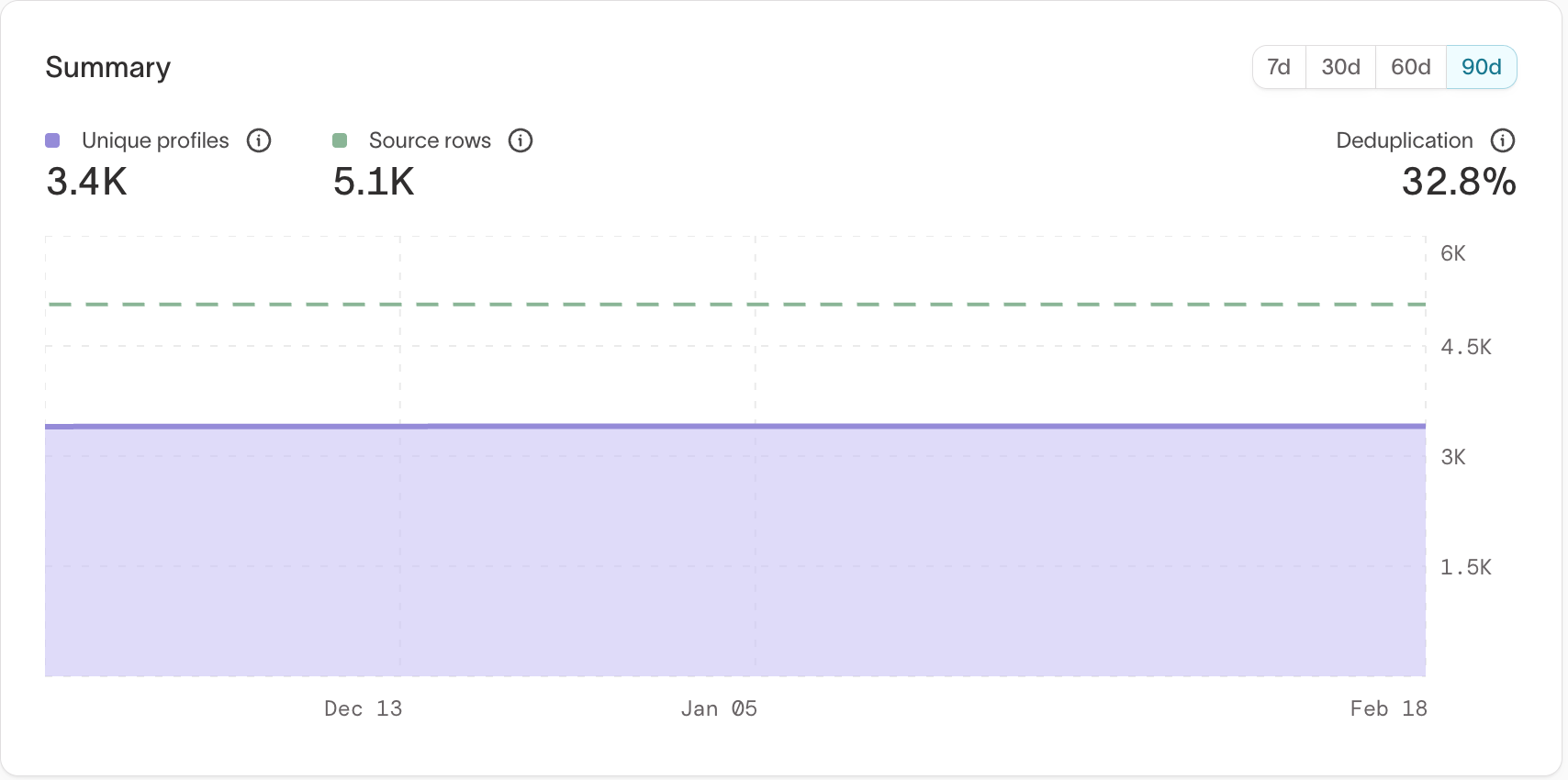
Identity Resolution groups input records that refer to the same real-world entity into resolved identities. It does this by building and maintaining an identity graph based on the identifiers and rules you configure.
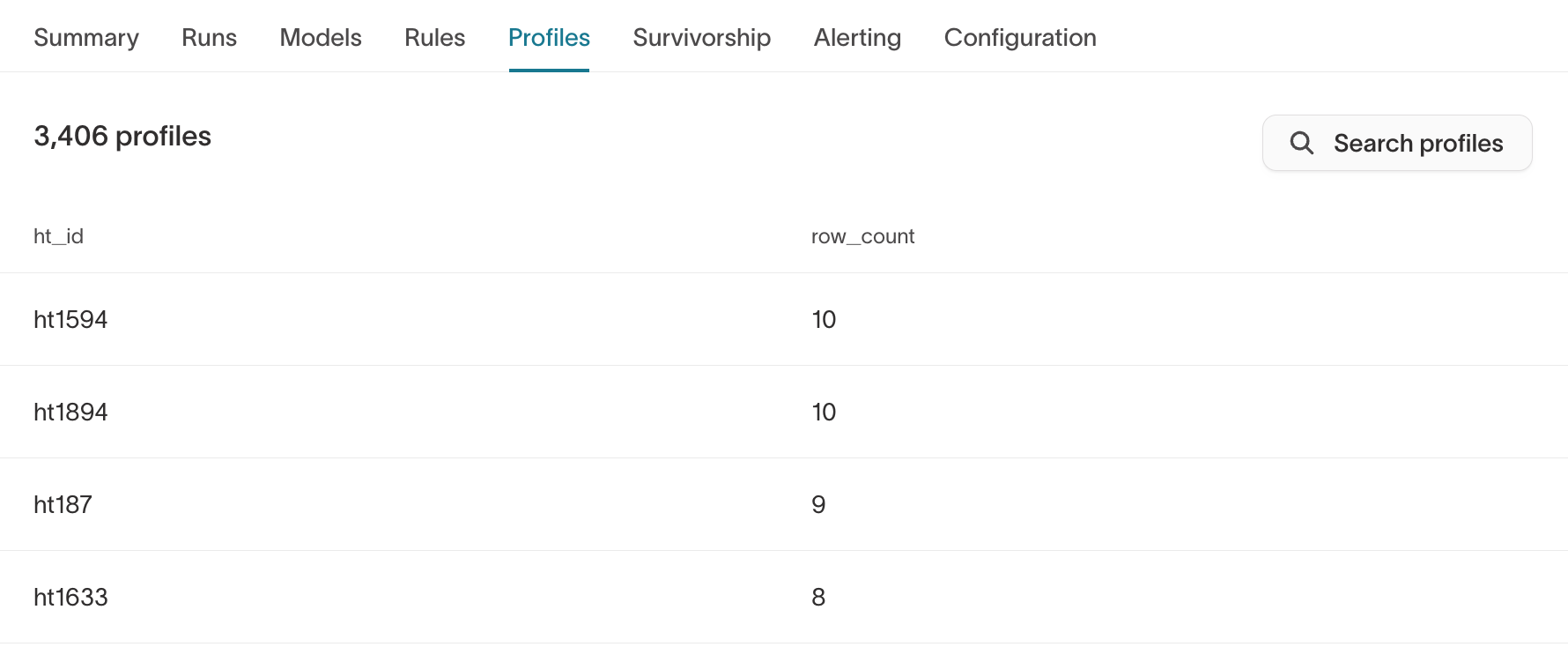
Each resolved identity is represented by a synthetic ht_id.
ht_idvalues carry over across incremental runs and full re-runs.- A profile's
ht_idchanges only when its records change, most often because two profiles merge or one splits. A merge collapses twoht_idvalues into one; a split turns one into two.
This page explains how Identity Resolution behaves conceptually, independent of any specific UI or setup steps.
Explore the interactive architecture diagram →
See how data flows and where Identity Resolution fits in your stack.
Identity graphs
An identity graph connects records through shared identifiers.
- Input records act as nodes
- Identifiers create edges between records
- Connected groups of records form resolved identities
If two records share a matching identifier (for example, the same email), they are connected in the graph. If no valid connection exists, they remain part of separate identities.
How records connect—and which connections are allowed—is entirely determined by your configured identifiers and rules.
Deterministic matching
By default, Identity Resolution uses deterministic matching, which relies on exact identifier equality.
With deterministic matching:
- Identifier values must match exactly to connect records
- Matching behavior is predictable and explainable
- Re-running the graph with the same data and rules produces the same groupings (excluding full re-runs or rule changes)
Deterministic matching provides a stable foundation for analytics, activation, and operational workflows where correctness and auditability matter.
Identifiers and merge priority
Identifiers define how records are allowed to connect in the identity graph.
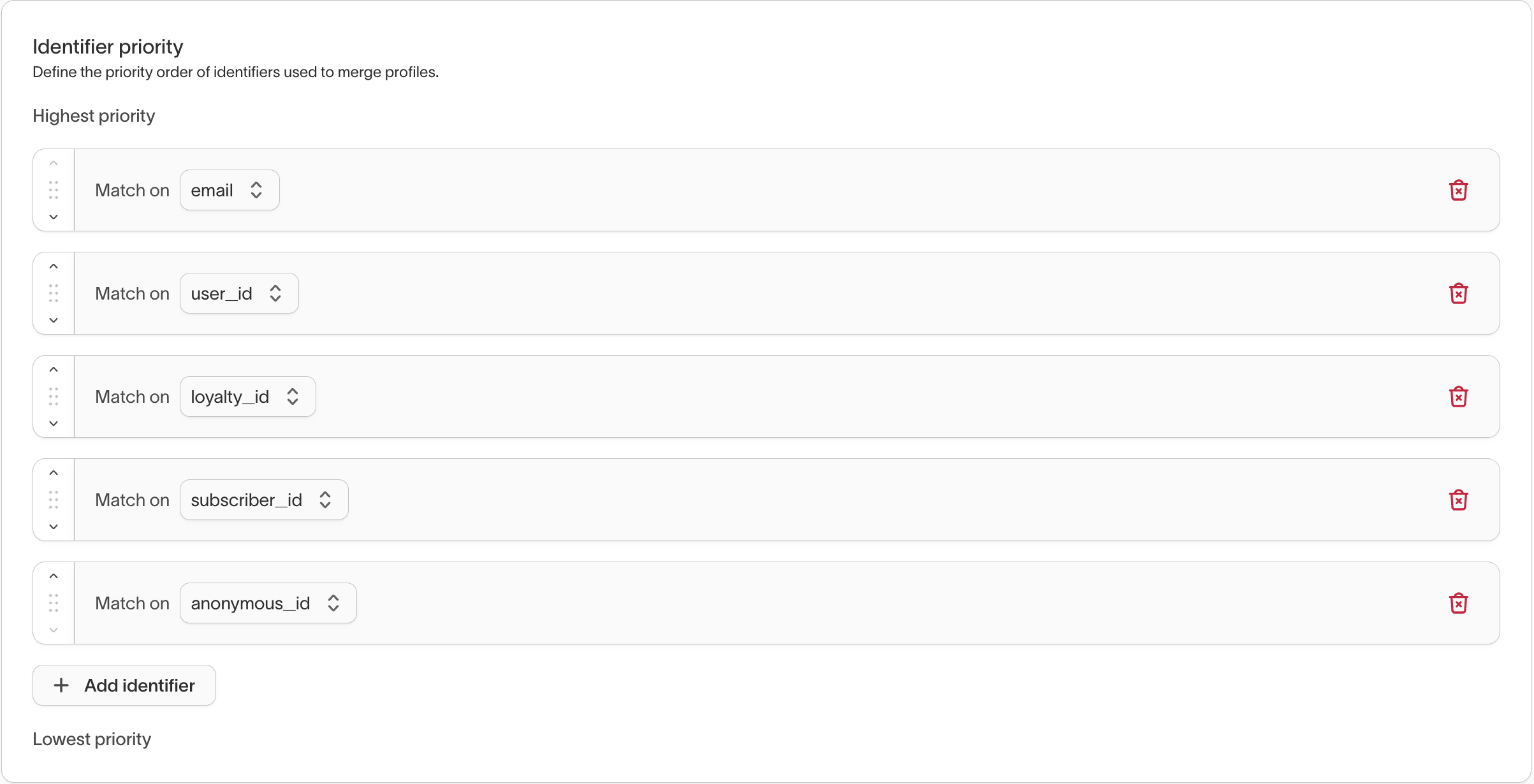
For each identifier, you configure:
- Which column contains the identifier value
- The priority order relative to other identifiers
- Optional limits on how many distinct values an identity can contain
When a record contains multiple identifiers, Identity Resolution evaluates them in priority order.
Higher-priority identifiers are applied first and can prevent lower-priority identifiers from creating unintended merges. This ordering controls how aggressively records are linked as new data arrives.
Identifier limits and over-merge protection
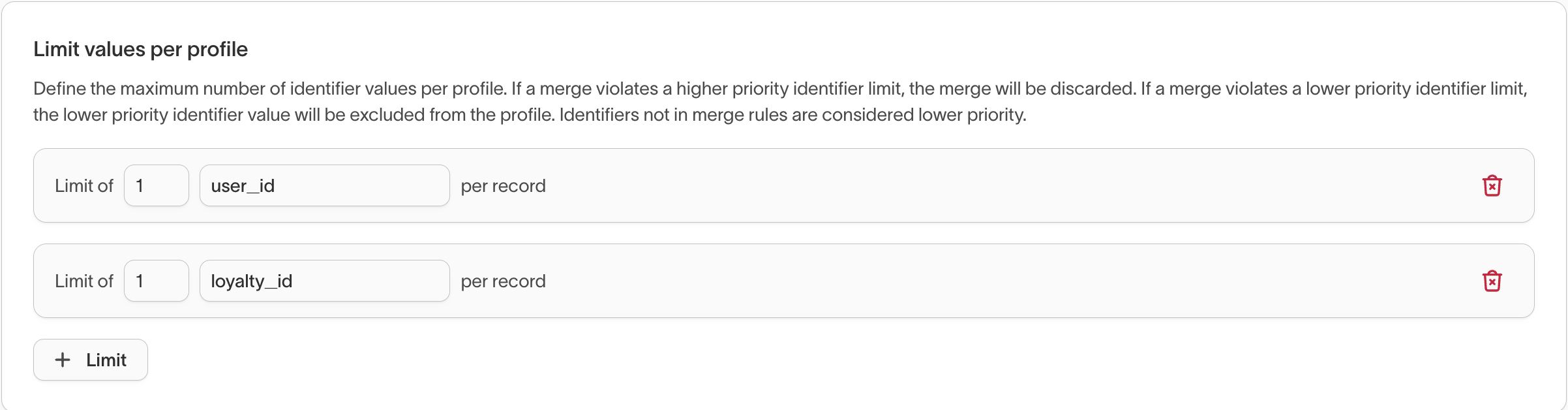
Identifier limits prevent identities from growing too large due to shared, reused, or low-quality identifiers.
A limit defines a rule such as:
“An identity may contain at most N distinct values of this identifier type.”
When a merge would violate a limit, Identity Resolution uses both priority and limits to determine the outcome:
-
Higher-priority identifier exceeds its limit
- The merge is blocked, and the record remains part of a separate identity.
-
Lower-priority identifier exceeds its limit
- The identity retains only the first N values.
- Additional values are ignored for matching purposes.
This behavior prevents unrelated records from collapsing into a single identity while still allowing high-confidence identifiers to drive resolution.
Incremental runs and identity stability
Every record gets its own ht_id when it is first ingested. A profile's ht_id is the lowest ht_id among its records, and it keeps that ht_id for as long as those records stay together.
Identity Resolution processes data incrementally as new or updated records arrive. Each input model's timestamp column determines which rows are net new and need to be processed.
During incremental runs:
- Existing identities typically retain their
ht_id - New records attach to existing identities when matches are found
- New identities are created when no valid matches exist
- Previously separate identities may merge if new data connects them
When a merge happens, the lower-numbered ht_id absorbs the higher-numbered one. For example, if new data links ht10 and ht14, the two identities collapse into ht10 and ht14 is dropped. The dropped ht_id is no longer present in the next run's output, but all of its records appear on the surviving identity. This is expected behavior — it reflects that Identity Resolution has learned the two profiles refer to the same entity.
Full re-runs
A full re-run recomputes the graph from an empty state. This happens when:
- You make an identifier limit rule stricter — for example, lowering the threshold on an existing limit, or adding a new limit rule
- A large amount of bad data requires resetting the graph. Smaller corrections can usually be handled with the profile reprocessing API instead, which avoids a full re-run
After a full re-run, each record is matched back to its original ht_id, so a profile that re-forms with the same records keeps the same ht_id. In practice nearly every profile does.
A full re-run recomputes profiles from scratch, so it is the only time, other than reprocessing, that a profile can split. When one does, because of a stricter limit rule, a blocklisted identifier, or deleted source data, the ht_id stays with the record that first carried it. New ht_id values are always higher than any issued before, so a dropped id is never reassigned to a different profile.
For activation guidance, see Using ht_id as a sync key.
From resolved identities to profiles
Identity Resolution produces resolved identities represented by ht_id. How those identities are exposed downstream depends on how you consume the outputs.
Common patterns include:
-
Golden Record
- A flattened, one-row-per-identity table
- Uses survivorship rules (recency, frequency, source priority, arrays) to select canonical values
- Often used for analytics, activation, and Customer 360 use cases
-
Customer Studio
- Uses Golden Record as the parent model
- Allows non-technical users to define traits, audiences, and journeys
A resolved identity exists independently of Golden Record. Golden Record and Customer Studio define how identities are represented and consumed, not how they are resolved.