Your competitive advantage isn’t just your data; it’s the intelligence you’ve built on top of it to predict customer behavior and drive action. The customer lifetime value predictions, churn propensity scores, and recommendation engines your data science team has built represent years of investment and domain expertise that competitors can't replicate. These models answer the critical questions that drive your business: Which customers are most valuable? What products should we recommend? When is someone likely to churn?
You've solved the hard problem. The remaining challenge is operational: turning those insights into action across millions of customers.
The operational gap
Every company with sophisticated ML faces the same operational challenge. Your models provide predictions, but turning those predictions into personalized experiences at scale requires additional tools and capabilities.
1. Your ML models provide strategic intelligence
Your models answer foundational questions about customer behavior and value. They provide competitive differentiation because they encode deep institutional knowledge that competitors can't replicate.
2. The gap: Turning insights into personalized experiences
Taking those predictions and turning them into action requires deciding when to reach out, through which channel, with what message, how often to engage, and how to coordinate across email, SMS, push, and onsite experiences—for millions of customers simultaneously.
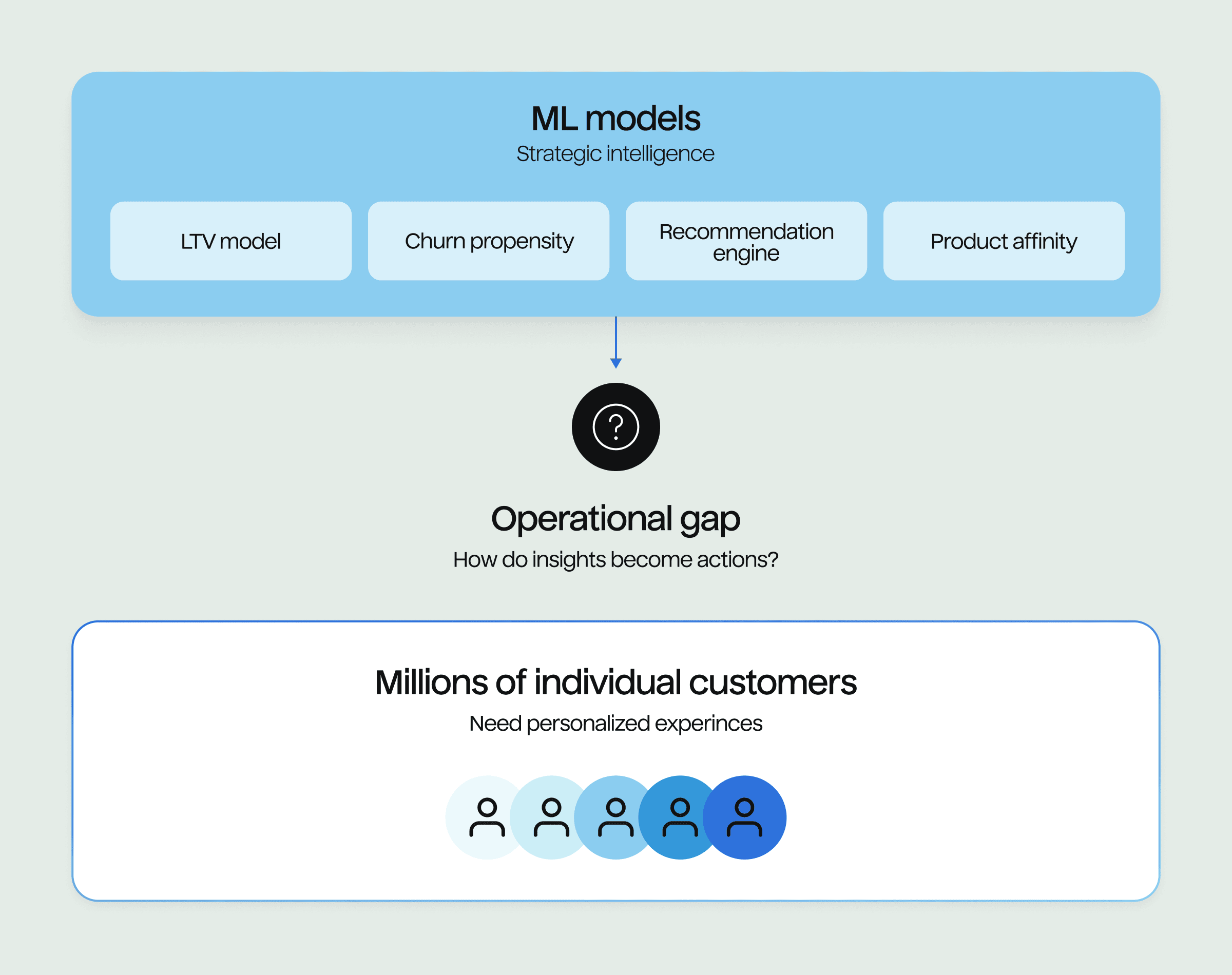
Most teams still rely on static rules, segments, and journey builders that are too rigid to personalize at the individual level and too slow to adapt as customer behavior changes. Without this operational infrastructure, even the best ML models remain underutilized because nothing translates their intelligence into real execution.
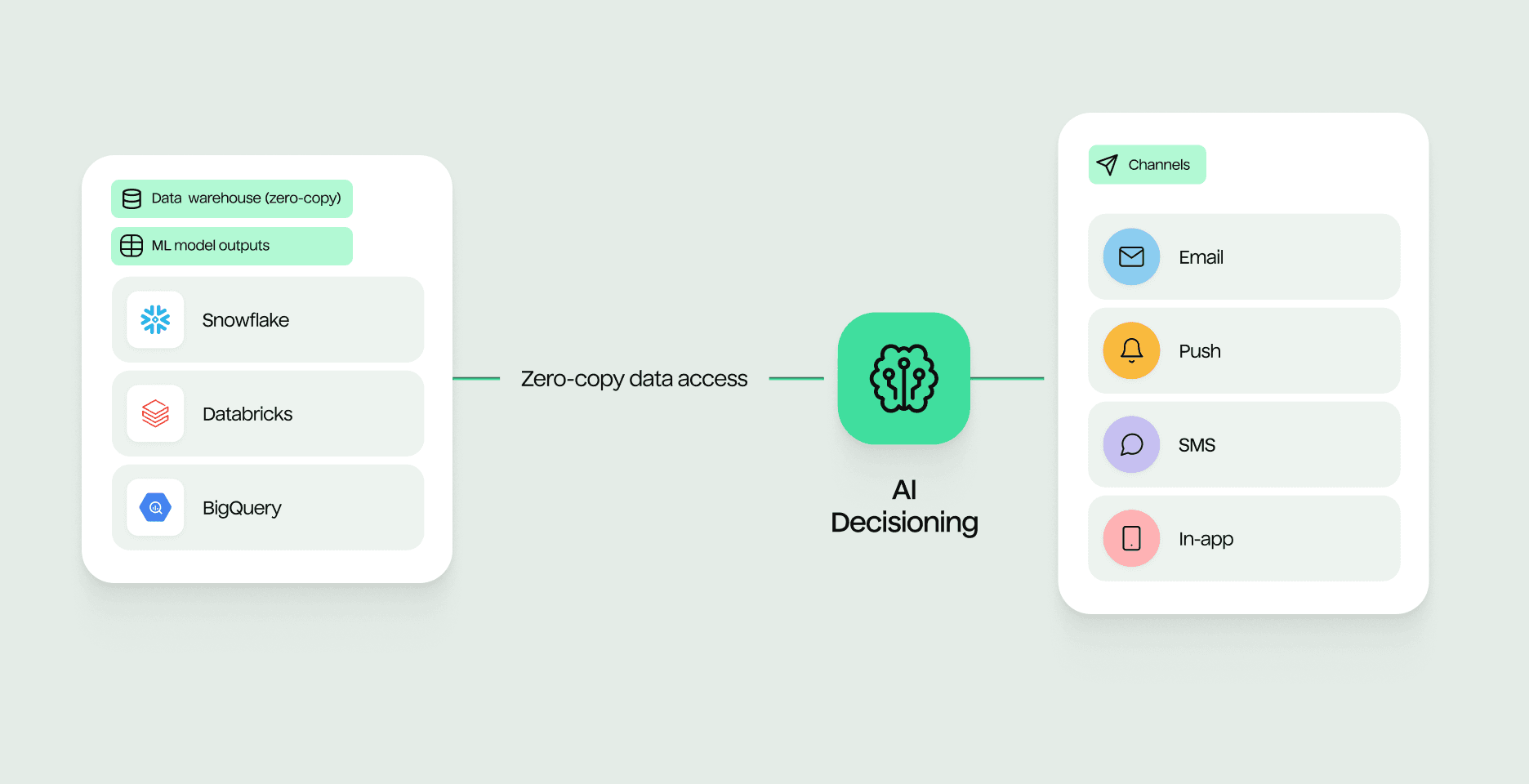
AI Decisioning bridges this gap by ingesting your ML outputs as context and using them to drive every customer experience decision—learning and optimizing continuously on its own to drive more of your desired business outcomes.
How AI Decisioning integrates with your ML work
AI Decisioning provides the operational tooling your models need. AI Decisioning connects seamlessly to your existing data environment—including Snowflake, Databricks, and BigQuery—so your team can get up and running fast without heavy IT involvement or complex setup. Your existing models and data stay exactly where they are, giving your team full control while unlocking personalization at scale. And because it's modular, you can adopt it alongside your existing CDP and email service provider without ripping and replacing your current stack.
Your models as contextual intelligence
Every prediction your models make becomes input for AI Decisioning's contextual bandits. Your ML predictions—like LTV scores, churn risk, and product affinities—are automatically surfaced within AI Decisioning, so marketers can act on them instantly without any manual data work.
Here's what this looks like: your models output LTV scores, churn risk, and product affinities for each customer. AI Decisioning uses these predictions as context to learn patterns across your customer base. It may determine, for example, that high-LTV customers with low churn risk respond best to exclusive previews sent Wednesday evenings, while similar customers with outdoor gear affinity convert better with adventure-themed messaging.
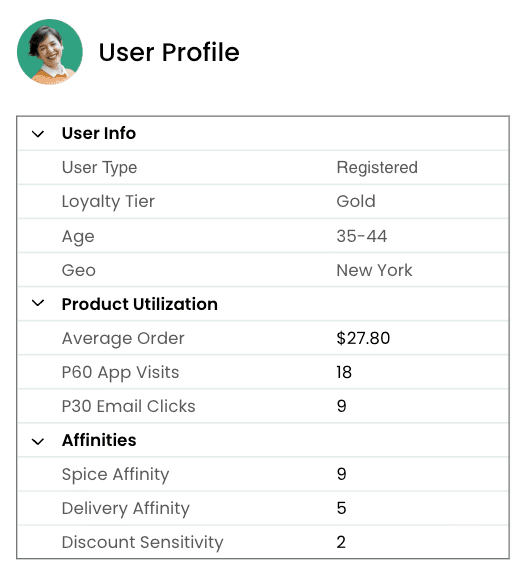
Your ML predictions provide the strategic intelligence. AI Decisioning learns how to leverage that intelligence for each individual customer. Better predictions lead to faster learning and better decisions. Even if your propensity models only update periodically, the decisioning layer learns continuously from outcomes between score updates.
Real-time model invocation
For recommendations that your team wants to own (e.g., product catalogs, inventory availability, personalized offers), AI Decisioning can query your ML models at decision time.
Here's the flow: AI Decisioning determines the optimal moment and manner to engage a customer. At that moment, it calls your recommendation API to get the current product recommendation, injects it into the message, and sends it. Your recommendation logic stays under your control. AI Decisioning handles the recommendation execution.
As your models improve, AI Decisioning automatically adapts. You retrain your LTV model with new features? The contextual bandits observe the updated scores and adjust. You deploy a better recommendation algorithm? AI Decisioning starts calling the new API and learning from the improved suggestions. Your ML work compounds over time.
How a subscription app drove results
A leading subscription app had invested heavily in ML: recipe recommendations, LTV models, churn scoring, and ingredient preference algorithms. When they implemented AI Decisioning, they didn't replace any of it.
AI Decisioning read their model outputs from the warehouse and learned patterns: high-LTV customers with low churn risk responded best to new recipe announcements via email five days after their last purchase. At-risk customers needed retention messaging via push notification with health-benefit framing. At decision time, it called their recipe API to inject personalized meal suggestions.
The result? Their ML models went from powering batch campaigns sent to segments to driving 1:1 personalization for millions of customers. Their data scientists never had to build decisioning infrastructure. They kept improving the models that differentiated their business.
Focus on competitive advantage, not infrastructure
This same subscription company initially attempted to build AI Decisioning internally. After two years and millions of dollars, they learned an important lesson.
They successfully built contextual bandits that showed performance lift. But they couldn't build a platform that marketers could actually use. The algorithms worked, but the UI, observability, and integrations became the bottleneck. As their data science lead explained, "We built our own decisioning engine internally for two years. Although it showed lift, the tradeoff didn't make sense versus buying off the shelf and focusing on our data foundation and models that feed the platform."
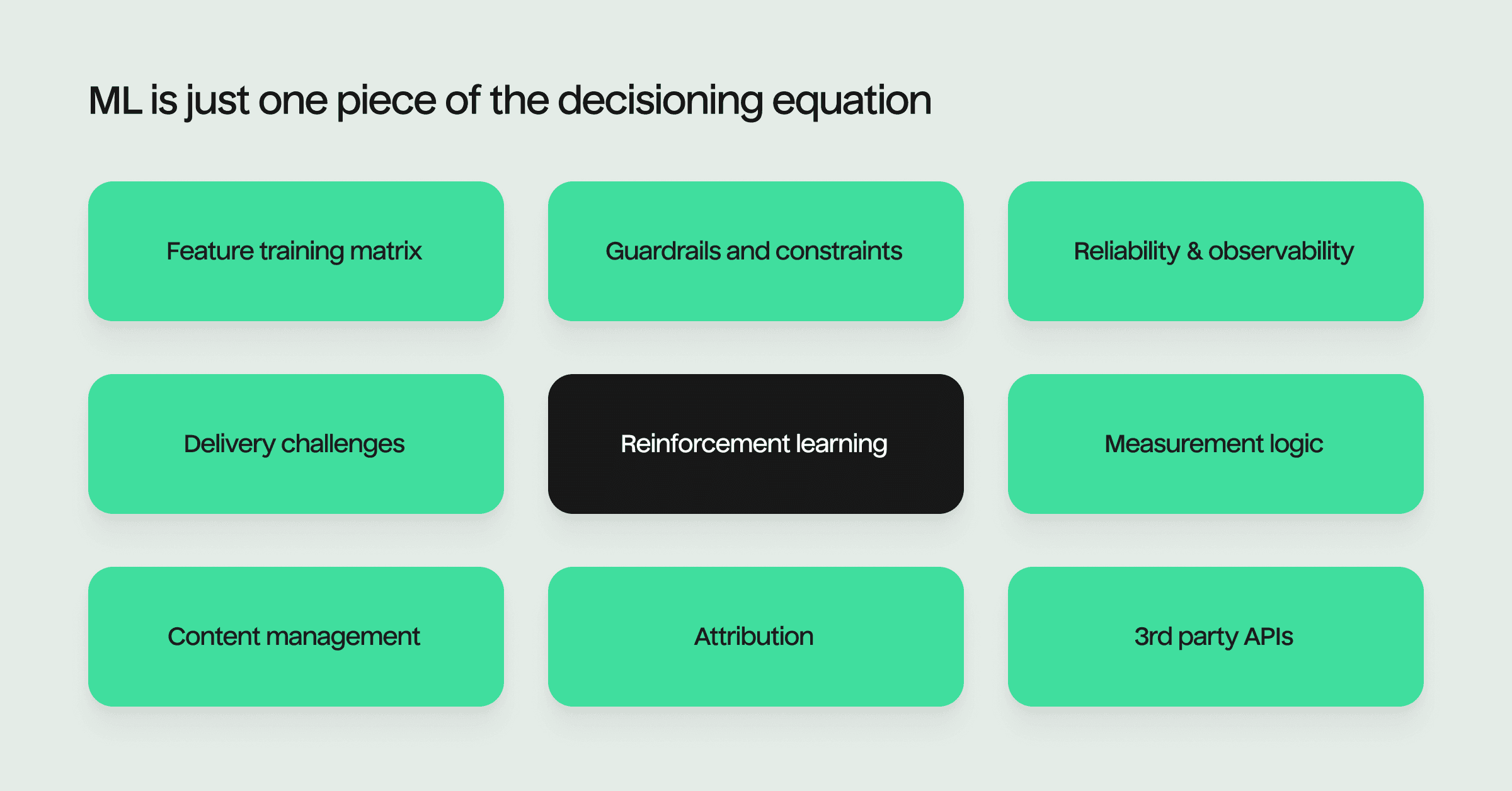
AI Decisioning isn't just algorithms. It combines contextual bandits and reinforcement learning with a marketer-first UI, observability, deep channel integrations, and continuous experimentation infrastructure. The system includes sensible fallbacks when data is sparse, allowing teams to scale 1:1 personalization without building a complex forest of rigid rules.
The composable approach is smarter
There’s always a choice between building vs. buying. As a guiding principle, teams should own what creates a competitive advantage and leverage existing platforms when they excel at operationalizing your work.
| What you should own | What you should leverage |
|---|---|
| Your proprietary ML models | AI Decisioning infrastructure that operationalizes your models |
| Next best product recommendations | Contextual bandits that learn optimal execution |
| LTV predictions based on your business model | Omni-channel orchestration engines |
| Churn models capturing customer dynamics | Marketer-friendly interfaces that enable self-service |
| Domain-specific algorithms |
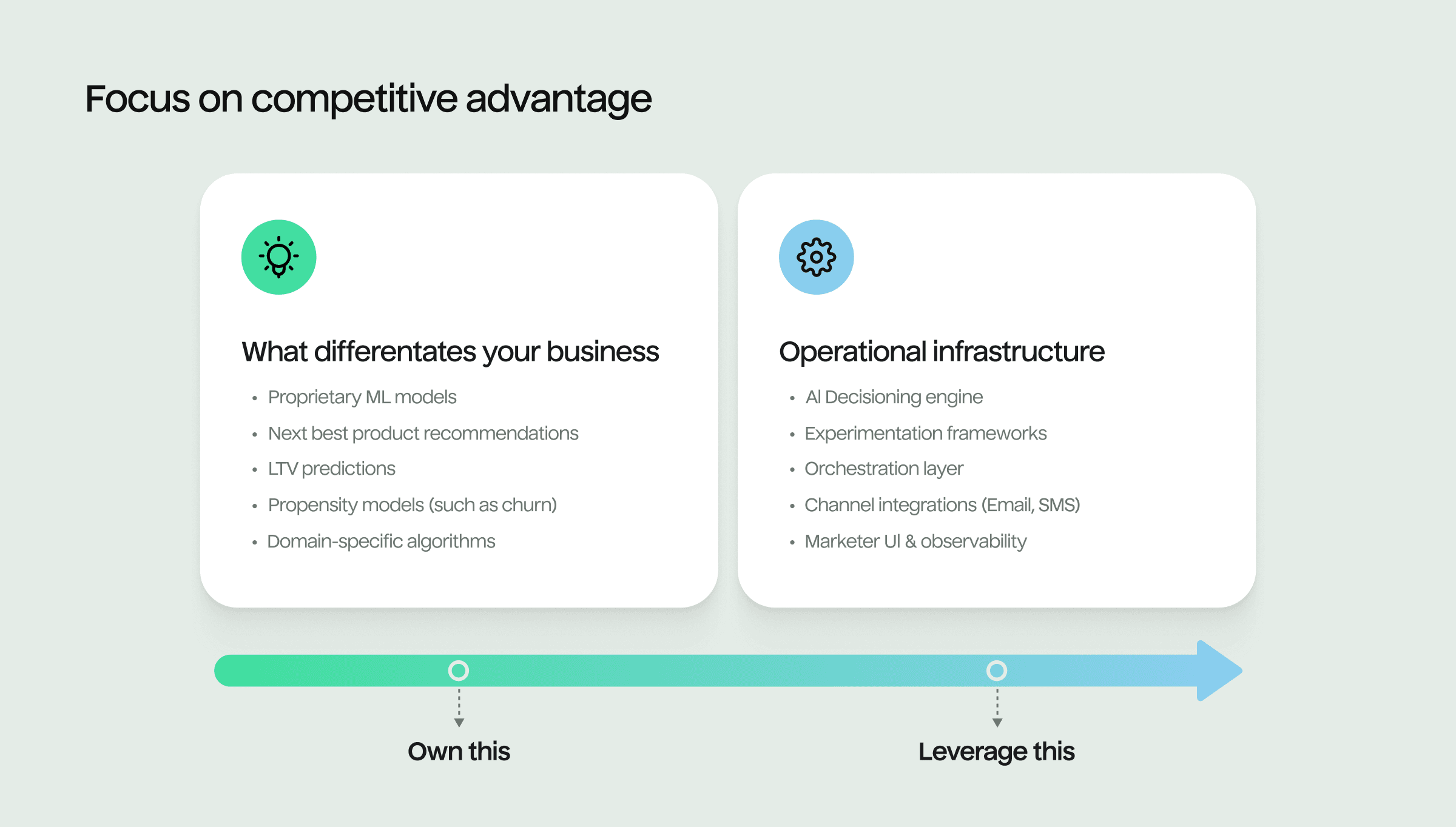
Your data and ML projects differentiate your business. AI Decisioning infrastructure gives your existing and continued investment more impact.
Getting started
To amplify your existing ML investments, start by taking inventory of your ML landscape:
- What predictions are you generating? (LTV scores, churn propensity, product affinities)
- Where do they live? (Snowflake tables, Databricks, BigQuery)
- How are they currently being used? (Batch segments, yes/no triggers, static emails)
Most organizations discover they have rich ML outputs that aren't being fully leveraged. AI Decisioning can amplify these investments immediately. Your existing models become more valuable without any retraining or rebuilding.
Start with one evergreen use case that yields steady outcomes. Identify the model outputs you'll integrate as contextual features and any endpoints you want to call at decision time.
Your ML infrastructure doesn't change. Your team keeps building what differentiates your business. The decisioning layer just makes it dramatically more impactful.
Ready to see how AI Decisioning can amplify your ML investments? Book a demo to explore integration patterns specific to your data infrastructure and existing models.